Online Business: Forget the Paperwork, This Is Punk Rock Entrepreneurship
25 May 2026

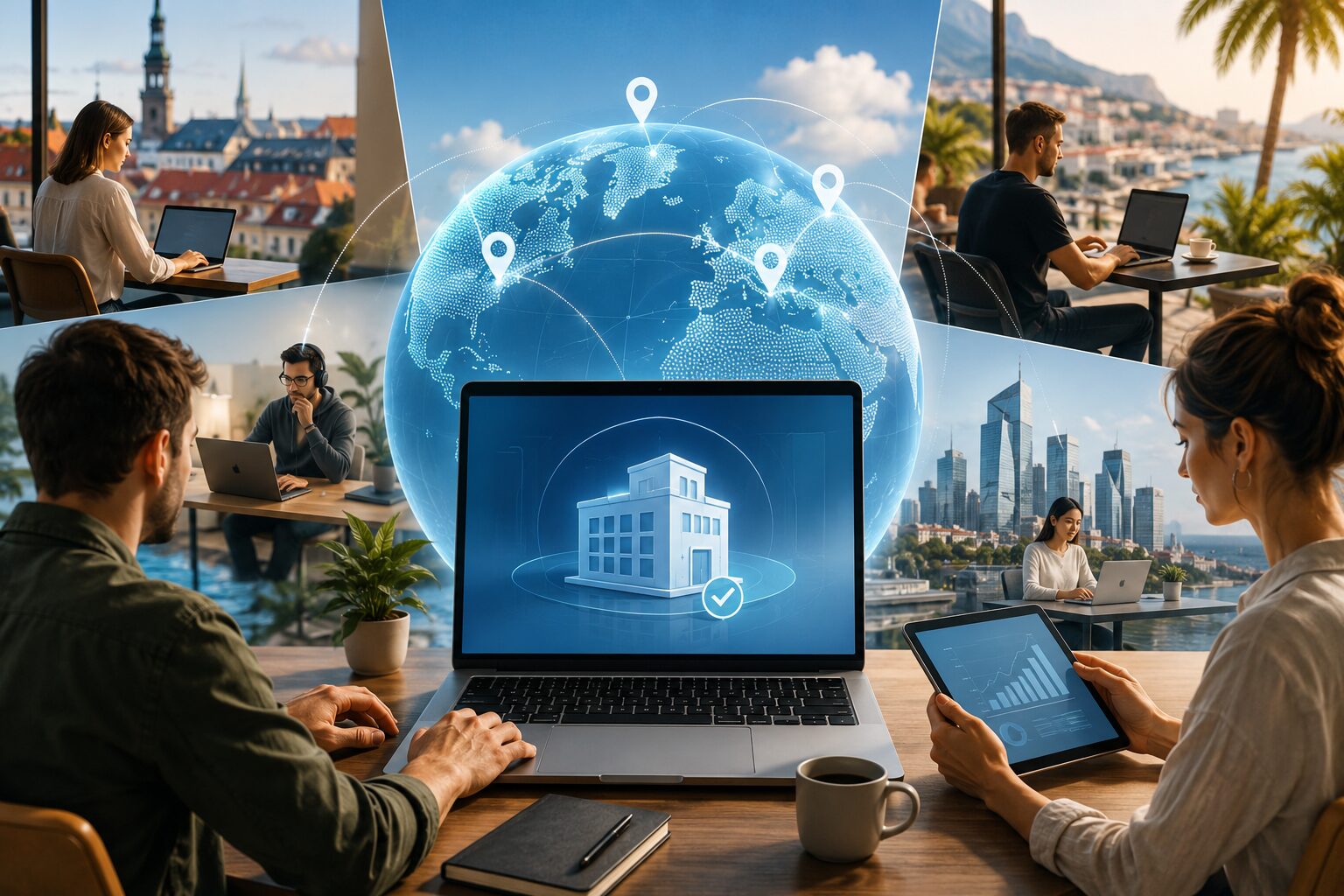
Walk into a café in Berlin, Lisbon, or Tallinn and look around carefully. The person next to you answering messages on their phone might be running a six-figure online business. Someone quietly editing documents on a laptop could be building a SaaS startup with customers in 20 countries. A couple discussing something over espresso may not be tourists at all, but business partners launching a media company entirely online.
That’s what makes modern entrepreneurship fascinating: It no longer looks like “business.”
There are no obvious signals anymore. No giant office towers, no formal uniforms and no corporate rituals announcing who is building something important. The internet flattened all of that. Now a serious business can operate from a backpack, a small apartment, or a café table beside someone ordering tiramisu.
And honestly, that’s what we love the most of today’s entrepreneurship!
You Might Be an Entrepreneur and Not Know It Yet
A lot of people still imagine entrepreneurs as a special category of humans. Risk-takers. Startup founders. Tech geniuses. The type of people who pitch investors in expensive conference rooms.
But the internet quietly changed the definition.
Today, entrepreneurship is often just a professional deciding:
“I want to build something that belongs to me.”
That’s it.
Maybe you’re a designer tired of depending on clients, or you’re a lawyer thinking about packaging your expertise into digital products. Perhaps you’re a marketer who realizes you already understand how attention works online better than most agencies.
The strange part is that many people already have the skills needed to run a business. They simply haven’t realized the tools now exist to operate independently.
Because in 2026, one person can function like an entire small company.
You might wonder: what are the best uses of AI for someone building a startup today?
- As a sales department, AI agents can automate huge parts of lead generation, follow-ups, and customer qualification.
- As a marketing agency, online tools now simplify content creation, reporting, ad generation, and social media distribution.
- As an operations assistant, AI can summarize meetings, organize workflows, and handle repetitive administrative tasks.
- As a customer support layer, automated systems can answer questions, onboard users, and maintain communication 24/7.
- As an analytics partner, dashboards and AI reporting tools can turn raw numbers into actionable business decisions in minutes.
The Rise of the “Mini Corporation”
One of the biggest economic shifts happening right now is invisible to most people.
Professionals are becoming miniature corporations.
A freelancer is no longer “just a freelancer.” A creator is no longer “just posting online.” With the right systems, one individual can operate with the leverage that previously required entire teams.
A consultant in Amsterdam can use AI tools to generate marketing campaigns, automate follow-up emails, manage scheduling, and create content pipelines while working alone. A developer in Prague can launch software globally without hiring local infrastructure. A strategist in Barcelona can sell expertise worldwide directly from social platforms.
The old idea of “scaling” used to mean hiring more people. Now it often means building better systems.
You might ask: what are modern entrepreneurs actually optimizing for now?
- Automation that removes repetitive work and creates operational efficiency.
- AI workflows that allow small teams to execute like much larger companies.
- Content distribution systems that generate visibility without depending on traditional advertising.
- Audience building strategies that create direct relationships with customers online.
- Asynchronous operations that allow businesses to function across multiple countries and time zones.
The goal is no longer to build the biggest company possible.
For many people, the goal is to build the smartest one.
Your Phone as a Business Infrastructure
Ten years ago, starting a serious company still felt intimidating.
Today, a teenager with a smartphone has access to tools that would have looked absurdly powerful in 2010.
You might think: what can someone realistically build directly from a phone today?
- Launch a personal brand, online store, or digital product in a matter of hours.
- Create advertisements, videos, and written content using AI-powered creative tools.
- Process international payments and manage customers from almost anywhere.
- Build automated email funnels and online communities without technical teams.
- Create AI agents that assist with research, scheduling, communication, and operations.
The barriers collapsed faster than society psychologically adapted to them.
That’s why modern entrepreneurship feels strange sometimes. The infrastructure became invisible.
You no longer “see” businesses being built because the tools are lightweight now.
Someone sitting quietly in a train station in Vienna might be negotiating contracts. Someone checking notifications while waiting for pasta in a small Italian restaurant in Milan could be managing a remote team across four countries.
The internet made entrepreneurship ambient.
It’s everywhere now.
The Most Interesting Companies Don’t Look Like Companies
This is where things become culturally different.
Traditional businesses were designed to appear impressive:
- headquarters
- office floors
- reception desks
- formal hierarchies
- visible scale
Internet-native businesses often look almost invisible from the outside.
A small online education company can outperform a traditional training institution. A niche media brand can compete with major publications. A solo founder with strong distribution can generate more attention than entire marketing departments.
And because AI reduces repetitive work, small teams can suddenly move incredibly fast.
That speed changes behavior.
Modern founders launch earlier. Test ideas faster. Build audiences before products. They treat business more like iteration than ceremony.
There’s a story that repeats itself constantly now: someone starts posting online consistently “just for fun,” gains an audience, launches a small service or product, automates half the workflow with AI, and suddenly realizes they accidentally built a real company.
That path barely existed fifteen years ago.
Now it’s one of the most common ways businesses are born online.
Why Modern Entrepreneurship Feels Like Punk Rock
Punk rock was never really about music. It was about bypassing permission.
You didn’t wait for a record label. You created your own thing, distributed it yourself, found your audience, and ignored the institutions telling you how success was supposed to look.
That same energy exists in modern online business.
You might ask: why does entrepreneurship today feel culturally different from traditional business?
- People can build audiences independently without depending on large institutions.
- Niche expertise can now become profitable through content, products, and communities.
- Remote operations allow founders to build globally while living almost anywhere.
- Small creators and startups can compete directly with large corporations online.
- AI tools dramatically reduce the amount of manpower required to launch and operate a company.
That changes who gets to participate.
You no longer need to look corporate to build something meaningful. Some of the smartest entrepreneurs today work from laptops in cafés, travel constantly, or build businesses quietly while maintaining completely ordinary-looking lives.
The next great company might not be built inside a glass skyscraper, it might just be started by you right now!
That’s the first step to start and have a chat to discuss your ideas and how we can help registration, accounting, compliance, etc.